The innovation
Seabreath Wave Energy introduces a new generation of high‑efficiency technology that transforms ocean waves into clean, reliable power.
The device is nearshore, floating, modular, multi‑chamber system based on the Oscillating Water Column (OWC) principle, engineered to maximize energy capture and operational resilience.
Thanks to its ability to harvest a large portion of the wave and its unique technical architecture, Seabreath stands out as a next‑generation flagship solution in the wave‑energy sector.
The system generates a continuous, unidirectional airflow, enabling the use of a single high‑efficiency unidirectional turbine serving all chambers. This multi‑chamber OWCs configuration delivers approximately +100% efficiency of traditional OWC systems equipped with Wells turbines, eliminating the losses caused by acceleration and deceleration cycles.
External compensation valves (not shown in the images), increasing efficiency by up to 30%.
Designed for near‑shore deployment, the platform is modular, scalable, easy to transport and install, and creates additional usable surface area. Its environmental footprint is virtually zero—and can even be positive, contributing to fish repopulation and acting as a breakwater to mitigate coastal erosion.
The structure is engineered to be manufactured from recycled shipping containers, which serve both as oscillating chambers and as transport units, significantly reducing production and logistics costs.
Seabreath is built to withstand extreme marine conditions and incorporates a robust, non‑electronic automatic safety system.
Noise emissions—typically a major issue for OWC devices—are reduced to the soft “breath” of the external valves, which inspired the company’s name.
The project is entering TRL 6
Working
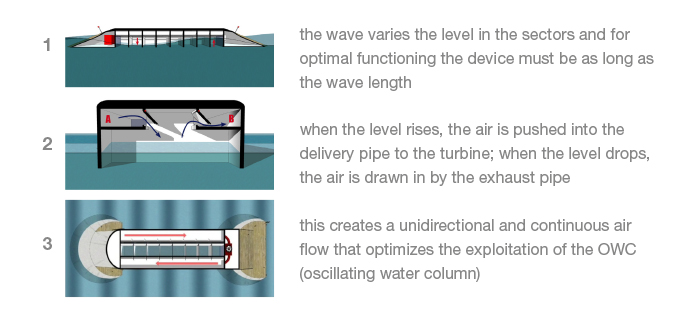
Seabreath harnesses the pressure differential generated by ocean waves inside a series of chambers, channeling the resulting airflow through dedicated conduits to power the turbine. At the same time, the system draws air from the turbine’s exhaust, enabling continuous operation and capturing energy throughout the entire oscillation cycle.
Advantages
⚡ Exceptional Efficiency
Seabreath delivers a step‑change in performance. Its energy conversion efficiency is approximately twice that of conventional OWC systems, enabling higher output from smaller, more cost‑effective units.
💸 Ultra‑Low Cost of Deployment
Every aspect of the system—manufacturing, transport, installation, removal, and maintenance—has been engineered for minimal cost and maximum simplicity. This dramatically reduces both CAPEX and OPEX.
🔧 High Versatility
The modular architecture allows flexible construction, easy shipping, rapid assembly, and seamless adaptation to the characteristics of any installation site. This versatility keeps costs low while expanding the range of viable markets.
🌊 Coastal Protection Built‑In
Beyond energy production, the device functions as a breakwater, mitigating coastal erosion and protecting shorelines—an added value for municipalities and coastal infrastructure owners.
🏗️ Creation of Usable Space
At larger scales, the system becomes a multi‑purpose floating pier, unlocking new commercial opportunities such as tourism, aquaculture, logistics, and waterfront services.
🌱 Environmental Sustainability
Seabreath is designed for near‑zero environmental impact:
• Renewable energy generation
• Recycled materials
• No pollutants
• Natural habitat enhancement for marine flora and fauna
• Noise levels comparable to light breathing
In many cases, the ecological impact is not just neutral—it is positive.
🌪️ Engineered for Extreme Conditions
The structure is exceptionally robust and equipped with an emergency safety system. It is designed to withstand waves up to 30 meters, ensuring reliability even in the harshest marine environments.
Architecture
Seabreath uses a floating multichamber OWCs converter designed to optimize hydrodynamic coupling and stabilize airflow to the turbine. The multichamber configuration reduces pressure variability, attenuates peaks from irregular waves, and maintains a more stable efficiency curve than monolithic OWC systems. The floating structure eliminates foundations, reduces bending moments, and simplifies maintenance through tow-to-shore operations.
To the main idea we added several innovations, such as a single‑chain anchoring system that does not damage the seabed and offers exceptional strength for the nearshore applications we target, as well as a modular tubular lattice structure and more.
The most important feature is that a unidirectional flow can use a turbine with much higher efficiency compared to the bidirectional turbines generally used in OWC systems.
Distinctive Technical Elements
Internal geometry optimized for wave-to-air energy conversion
No submerged mechanical parts, reducing corrosion, biofouling, and fatigue-related failures
Linear modularity enabling controlled scaling
Chamber tuning to match local wave spectra
Failure Modes and Mitigations
Typical sector failure modes:
Structural fatigue, water ingress, dynamic instability, accelerated degradation of submerged components, high offshore OPEX.
Seabreath mitigations:
Strong lactice structure, no submerged mechanical parts, predictable floating dynamics, tow-to-shore maintenance, modular component replacement.
TRL and Maturation Pathway
Current TRL 4–5 with validated hydrodynamics and patents.
Next steps: TRL 6 (full-scale prototype), TRL 7 (operational demonstrator), TRL 8–9 (pre-commercial and industrial deployments).
Certification Pathway
DNV-GL guidelines for hydrodynamic and structural validation, extreme-condition survivability tests, third-party LCOE and performance certification.
CAPEX/OPEX and Competitive Advantage
CAPEX: reduced through no foundations, modular production, standardized materials.
OPEX: drastically reduced through absence of submerged mechanics, tow-to-shore maintenance, modular replacement.
Impact: pathway to competitive LCOE (40–80 €/MWh, with potential 30–70 €/MWh at scale).
Industrial Roadmap
TRL 6 prototype → TRL 7 certification → TRL 8 pilot series → TRL 9 industrial scaling.
OPERATION LABORATORY TEST TESTS REPORT EXPECTED RETURNS
Notice: The pictures are only indicative and do not show the smart mooring system, the floating system, the emergency system, the supporting structure and other parts.
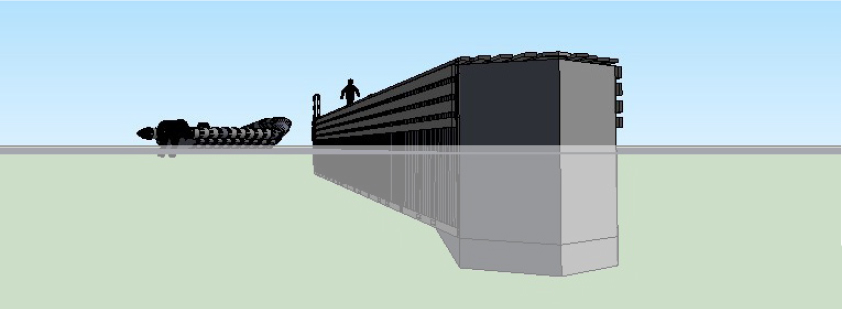
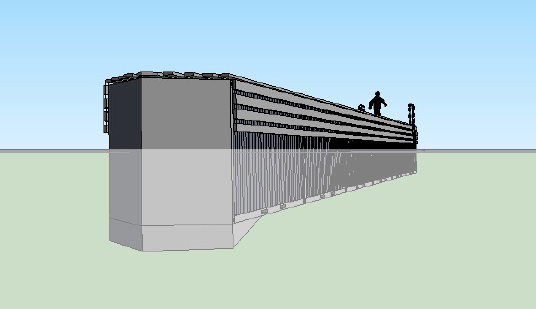
120 ft prototype


Contacts
SEABREATH LLC
Str. Val Parma 18 – 43124 Parma – ITALY
CF/PI: 02862900343 – REA: PR-272956 SDI: BA6ET11