Overview
“Think of the motion of the waves, the ebb and flow of the tides and the coming and going of the waves. What is the ocean? An enormous lost strength. How stupid the earth, not to make use of the ocean!”
( Victor Hugo – Novantatré, (1874), VII, 5)
The first wave energy patents date back to the late 1800s, and over the years, a wide variety of patents have been filed and a multitude of developments have been developed, so much so that the various WECs (wave energy converters) have been classified into different categories.
The main problem facing the sector is the particularly harsh environment and poor efficiency, which made these technologies difficult to adopt and expensive.
Their costs were 3 to 5 times higher than other sources, which also posed environmental problems.
In the past years, the Oscillating Water Column had generated renewed enthusiasm due to its survivability, as it has no moving mechanical parts. However, it still lacked competitiveness with other sources and faced the problems of low-efficiency turbine, environmental issues due to the type of system and noise pollution from the external exhaust air.
These problems have been solved
Potential resources
Given the growing demand for energy from emerging countries and the increasing cost of fossil fuels, unit to the need to limit emissions of CO2 and the emission of pollutants into the environment, the future of production energy can only be given to the use of renewable energy sources.
Renewables are by their nature “discontinuous”, therefore it is desirable a mix of sources renewable for the future to create a smart grid.
In addition to traditional energy sources it looms for the future the use of a source that until now it has been excluded: the exploitation of the enormous amount of energy contained in the oceans.
The waves are a form of renewable energy created by wind. The capture of wave energy has been shown to be technically feasible in different forms.
Annual average wave energy flux in kW per meter of wave front
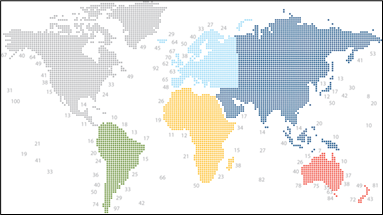
Wave energy has significant global potential with the USA, North & South America, Western Europe, Korea, Japan, South Africa, Australia and New Zealand among some of the best wave energy sites around the world
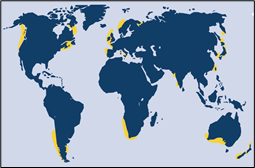
Compared to other forms of renewable energy, such as solar photovoltaic (PV), wind or ocean currents, energy from wave motion is continuous but highly variable, even though the levels of wave at a given location can be confidently predicted a few days in advance and the PLF (Power Load Factor) linked to this source may be very high: 80-90%.
Because the wind is generated by an irregular solar heating, the energy of the waves can be considered a form of concentrated solar energy. The levels of solar radiation which are of the order of 100 W/m2 are transferred into waves with (…) of wave front. The transfer of solar energy to the waves is greater in areas with strong winds (especially between 30 ° and 60 ° of latitude), near the equator thanks to the persistent winds, and near the poles due to storms polar, and also, at the increase of distances the quantity of energy stored increase.
The waves are also effective “carriers” of solar energy. In deep water waves can travel thousands of miles and to hold on much of the energy. The wave energy[1] is dissipated after it reaches sea bottom that are less than ~ 200 m depth. At a depth of 20 m the wave energy is reduced generally to about one third of the initial energy. It has been estimated that the total annual energy available from waves off the coast of the United States (including Alaska and Hawaii), calculated at a water depth of 60 m, is 2,100 terawatt hours (U.S. Department of the Interior). This estimate was performed at a water depth of 60 m indicate (regardless of the distance from the coast in which this occurred depth) in order to allow comparison of ‘energy from wave motion between the different coastal areas, and to eliminate the possible and unpredictable loss of energy of the wave given by its interaction with the seabed of smaller depth. The wave energy is available in the U.S.: in areas of open sea in the Atlantic 2-6 kW / m, 12 to 22 kW / m in regions like Hawaii and 36-72 kW / m in the North West of the United States in coastal areas near Washington and Oregon.
[1] The common measure of wave power, P, is as follows: P = ρg TH ² ² / 32π watts per meter (W / m), the length of ridge (distance along a ridge individual), where: ρ = density of ‘seawater = 1025 kg/m3, g = acceleration due to gravity = 9.8 m / s / s, T = wave period (s), and H = wave height (m).
European potential
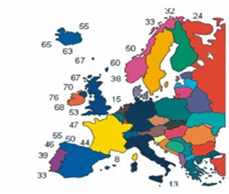
EU Member States are increasingly interdependent for energy, as they are in many other areas –i.e. a power failure in one country has immediate effects in others. A radical change is clearly required in the way energy is produced, distributed and consumed. This means transforming Europe into a highly efficient, sustainable energy economy. Europe’s dependence on imported energy has risen from 20% at the signing of the Treaty of Rome in 1957 to its present level of 50%, and the EC forecasts that imports will reach 70% by 2030. If energy trends and policies remain as they are, the EU’s reliance on imports will continue.
Technologies Already Used
Currently, only few plants use the energy of the sea in commercial installations, are much more numerous experimental facilities and prototypes, which are showing in many cases full economic feasibility and leave great hope for the future of these technologies.
Recently begin to emerge environmental impact problems given by both wind and photovoltaic plants. Notwithstanding that small plants spread of these sources do not subtract land and have little impact or almost zero, the problem arises for large industrial plants, as well as landscape problems begin to arise also problems of disposal of old systems, especially solar. These two areas are in decline.
The other sources of energy from the oceans[1] according with the U.S Department of Energy are:
- Ocean currents. global resource potential estimated at below 1,000 TWh/yr.
- Salinity gradient with global potential resources estimated around 2,000 TWh/yr.
- Thermal conversion with global potential resources estimated at around 10,000 TWh/yr.
- Tidal with global potential resources estimated at around 250 TWh/yr
These systems above have limits given by: small number of sites available for installations, greater environmental impact both landscape and wildlife, and lower efficiency.
The industrial production of energy from wave, with estimated global potential energy up to 80,000 TWh/y exploitable, does not present too many problems landscaped and does not require the use of toxic or polluting substances.
A variety of technologies are being studied for capturing energy from waves.
The various technologies are given by: terminators, attenuators, absorbers, and overtopping devices.
Terminators
Devices such as “Terminator” are usually installed on the ground or near-shore, floating versions have been designed for off-shore applications. The oscillating water column (OWC) is a form of termination in which the water enters, from an opening located below the surface, into a chamber in which air is contained. Wave action causes a movement of the level as a piston and pushes the air towards a turbine. A prototype full-scale 500-kW was designed and built by Energetech (2006) is being tested in the sea at Port Kembla in Australia, another project is under development in Rhode Island.
A project, which under construction has moved much closer to Seabreath, is the IVEC PTY LTD Australian, but has less efficiency because it does not provide by external valves of compensation.
Floating offshore project that uses the OWC is also the “Mighty Whale”, under development at the Marine Science and Technology Center in Japan since 1987.
Attenuators
Attenuators are long multi-segment floating structures. The different heights of level along the length of the device causes a bending in the connecting segments which are connected to hydraulic pumps or other converters. Among the attenuators with more advanced development is worth mentioning the McCabe and Pelamis by Ocean Power Delivery, Ltd. (2006).
The pump wave McCabe has three pontoons linearly hinged together. The pontoon in the middle is connected to a submerged damper plate which causes a resistance than caissons placed on the bow and stern. Hydraulic pumps are applied between the center and frames and are activated by the movement of the same. The hydraulic fluid under pressure can be used to activate a generator or to pressurize the water for desalination. A prototype full-size of 40 m has been tested off the coast of Ireland in 1996, and the device is already in the process of commercialization.
A similar concept is used by the Pelamis (designed by Ocean Power Delivery Ltd. [2006]). The Pelamis has four cylindrical floating caissons are 30 m long and 3.5 m in diameter connected by three hinged joints. The decline of the hinge joints, caused by the movement of the waves, active hydraulic pumps located in the joints. A full-scale prototype in four segments of 750 kW has been tested sea for 1,000 hours in 2004. For this test was followed by a first order in 2005 and a commercial WEC by a consortium led by Portuguese electricity Enersis SA. Currently the project Pelamis is stopped due to problems of structural failure.
Absorbers
A device of this kind is the PowerBuoyTM developed by Ocean Power Technologies. The construction includes a floating structure with a relatively immobile component, and a second component in motion caused by the waves (a buoy floating within a fixed cylinder). The relative motion is used to drive energy converters electromechanical or hydraulic. A demonstrator prototype PowerBuoy of 40 kW was installed in 2005 for a sea trial opened in Atlantic City, New Jersey. In the Pacific Ocean have been made other tests in 2004 and 2005 off the coast of Oahu Hawaii basis.
The WEC AquaBuOYTM under development by the Group AquaEnergy, Ltd. (2005) is an absorber which exploits the vertical movement of the buoy as a piston contained in a long tube under the buoy. The movement of the piston puts pressure sea water. The AquaBuOY was tested on a scale prototypes, and a demonstration plant offshore of 1 MW has been realized in Makah Bay, Washington. The Makah Bay demonstration consists of four units rated at 250 kW located 5.9 km (3.2 nautical miles) offshore in water about 46 m deep.
Other absorbers tested are the Archimedes Wave Swing (2006), which consists of a cylinder full of air which moves up and down to move the wave. This movement with respect to a second cylinder fixed to the seabed is used to drive an electric generator linear. A device with a capacity of 2 MW has been tested at sea in Portugal.
Overflow devices
The devices have overflow tanks which are filled by ‘shock waves to levels above the surrounding media. The released water tank is used to drive turbines or other conversion devices.
The overflow devices have been designed and tested both for onshore and offshore floating. The devices include the offshore DragonTM Wave (Wave Dragon 2005), which provides that wave reflectors focus waves towards the center of the structure and therefore increase the effective height of the wave.
The device overflow WavePlaneTM (WavePlane Production 2006) has a smaller tank. The waves are channeled directly into a room that conveys the water to a turbine or a conversion device.
Other minor tens of devices are currently under study and experimentation. However Seabreath has the highest level of technology known for the production of energy from wave motion.
Types of ocean energy sources and technologies
Types of ocean energy sources and technologies
OCEAN ENERGY SOURCES | DESCRIPTION | TECHNOLOGY TYPES |
Ocean wave | Energy sourced from movements of water near the surface of the earth in an oscillatory or circular process | Attenuator, Collector, Overtopping, Oscillating Water Columns, Oscillating Wave Surge Converter (OWSC), Point Absorber, Submerged Pressure Differential, Terminator, Rotor. |
Tidal current | Energy sourced by natural currents created by the movement of the tides. | Horizontal/Vertical-axis turbine, Oscillating Hydrofoil, Venturi. |
Salinity Gradient | The application of salinity gradients to store solar energy or to exploit the entropy of mixing fresh and salt water. | Semi-permeable Osmotic Membrane. |
Ocean Thermal Energy Conversion | OTEC draws energy from the thermal gradients that exist between the warm surface water and the cold deep water of the ocean. | Thermo-dynamic Ranking Cycle |
Technologies Innovation
Unlike large wind turbines, there is a wide variety of wave energy technologies, resulting from the different ways in which energy can be absorbed from the waves, and also depending on the water depth and on the location (shoreline, near-shore, offshore). Recent reviews identified about one hundred projects at various stages of development.
The number does not seem to be decreasing: new concepts and technologies replace or outnumber those that are being abandoned. Several methods have been proposed to classify wave energy systems, according to location, to working principle and to size (“point absorbers” versus “large” systems). See Top Ocean technologies in Figure 11, according with the level of development.
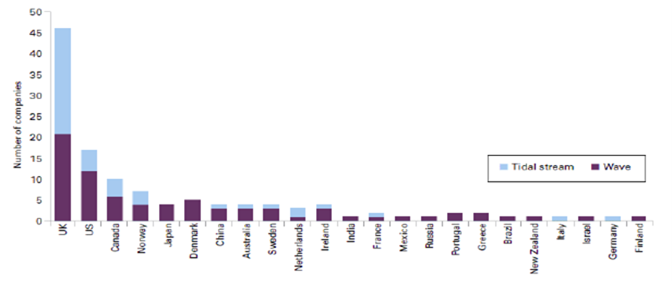
Some links of ocean top technologies:
Fixed:[1] Isolated: Pico,
In breakwater: Sakata, Tapchan
Floating: Mightywhale, Oceanenergy, Sperboy, Oceanlinx, Aquabuoy, IPS Buoy,
FO3, Wavebob, PowerBuoy, Pelamis , PS frog, Searev, Waveroller,oyster, AWS, Wavedragon
Oscillating water column: IEA Technology
[1] : , 2013
Benefits of wave energy
- High Energy Potential
The amount of power that comes from wave energy is enormous. “The total wave energy potential is estimated to be 32,000 TWh/yr (115 EJ/yr). This is roughly twice the global electricity supply in 2008 (16,000 TWh/yr or 54 EJ/yr).”
Wave energy contains roughly 1000 times the kinetic energy of wind. Hence, it allows smaller and less conspicuous devices to produce power. Also, water being 850 times as dense as air results in much higher power produced from waves averaged over time.
- Highly Predictable
“Waves arrive day and night, 24 hours a day, and have more inertia than solar/wind conditions, with less potential for sudden changes in the resource potential” (IEA-OES, 2014)
Sea wave energy has the highest concentration of renewable energy. Sea waves are the result of the concentration of energy from various natural sources like sun, wind, tides, ocean currents, moon, and earth rotation.
Unlike wind and solar; power from sea waves continues to be produced round the clock whereas Wind velocity tends to die in the morning and at night and Solar power depends on sun exposure; cloud coverage and nighttime hours reduce this exposure and efficiency. Of course, these other forms of renewable energy are still better than fossil fuels.
- Where Wave Energy Is Needed Most
“Worldwide there are 1.3 billion people living without electricity.” (International Energy Agency)
Two-thirds of the world’s population – 4 billion people – live within 400 kilometers of a seacoast. Just over half the world’s population – around 3.2 billion people – occupy a coastal strip 200 kilometers wide (120 miles), representing only 10 percent of the earth’s land surface. With this population distribution, increasing human numbers and mounting development, the need for sea wave energy for these coastal regions becomes evidently undeniable. (EWP)
- Wave Energy Reduces Environmental Impacts & Climate Change
Ocean energy offers the potential for long-term carbon emissions reduction and the environmental risks from ocean energy are relatively low.
“Ocean energy has the potential to deliver long-term carbon emissions reductions and has low environmental impacts. Ocean energy technologies do not generate Greenhouse Gases (GHGs) in operation and have low lifecycle emissions, providing the potential to significantly contribute to emissions reductions. Utility-scale deployments with transmission grid connections can be used to displace carbon-emitting energy supplies.” (Ocean Energy)
- Green Jobs
Remote communities and declining industries, such as, the shipbuilding industry are in despair when it comes to jobs and economic sustainability. The wave energy industry has the ability to create hundreds of thousands of ‘green jobs’.
“In addition to electricity generation with low lifecycle GHG emissions, the possible benefits of wave energy include industry stimulation for local shipyards (device construction and/or assembly), transportation, installation and maintenance.”(Ocean Energy, 2011) In addition, “exclusion areas for wave farms may create wildlife refuges, which may be a net benefit to fishery resources” (House of Commons, 2001)
The Organization for Economic Cooperation and Development (OECD) said, “ Growth potential for environmental employment is high.”
- Helping To Decarbonize The Global Electric Power Supply
Decarbonizing the electricity grid simply means reducing the carbon emissions produced as a result of using fossil fuels and other man-made contaminants that lead to greenhouse gas emissions and global warming.
“The traditional electric sector emits the most GHGs, responsible for 41 percent of the world Co2 emissions.” “…The electric sector is not only the largest source of global GHG emissions, but trends indicate that electricity consumption will grow.”(IEA-OES)
Wave Energy produces clean, zero-emissions electricity. It is not only a sustainable solution for the future, but a cost-effective one too.
- Export Potential
There is high exporting potential for wave energy. By adopting Wave Energy Converters (WEC) it is possible to exploit the abundant wave energy resource for electrical power generation production and export the electricity to surrounding areas and markets nearby benefiting economic growth locally.
- Low Energy Price Volatility
Wave Energy gives you the security of energy supply in volatile fossil fuel pricing. With the rising and falling uncertainty of fossil fuel prices, wave energy is a great alternative.


Contacts
Str. Val Parma 18 – 43124 Parma – ITALY
CF – PI: 02862900343
REA PR-272956
SDI: BA6ET11
Phone Number: +39 0521 645437
Email: info@seabreath.it